

Project Summary
Role
Team
Duration
Services
Method
-
Cloud Solutions Architect
-
Individual
-
1 month
-
AWS Amplify
-
API Gateway
-
DynamoDB
-
AWS Lambda
-
Lambda
-
CloudWatch )
-
IAM
-
Lean UX
Introduction
My team and I created an app that assists in educating beginner cooks and improving their cooking techniques and abilities. This app includes videos, blogs, tutorials, and more, giving multiple options for learning based on your learning style. In addition, this app can still be beneficial to experienced chefs with exclusive features geared towards improving time management and recipe alternatives.

Problem Space
The current state of meal prep and educational cooking applications has focused primarily on convenient meals and cooks with more experience. Existing products and services fail to consider the learning curve when preparing easy and healthy meals. Skillfulbites addresses this gap by providing personalized meal plans for differing dietary or planning restrictions based on the user's lifestyle.
Our teams initial focus was to create a solution for novice cooks who don’t have an abundant amount of time to learn how to cook. We knew we would be successful at doing this when we see feedback from the community that they’ve expanded their cooking knowledge based on shares, comments, likes, and activity throughout our application.
Proto-personas
Our team created a proto-persona named Brad which gave us a step towards a solution for what our users may need in the solution to help solve our problem.However, our proto-persona evolved over time after conducting extensive research and multiple interviews for helping find a solution.
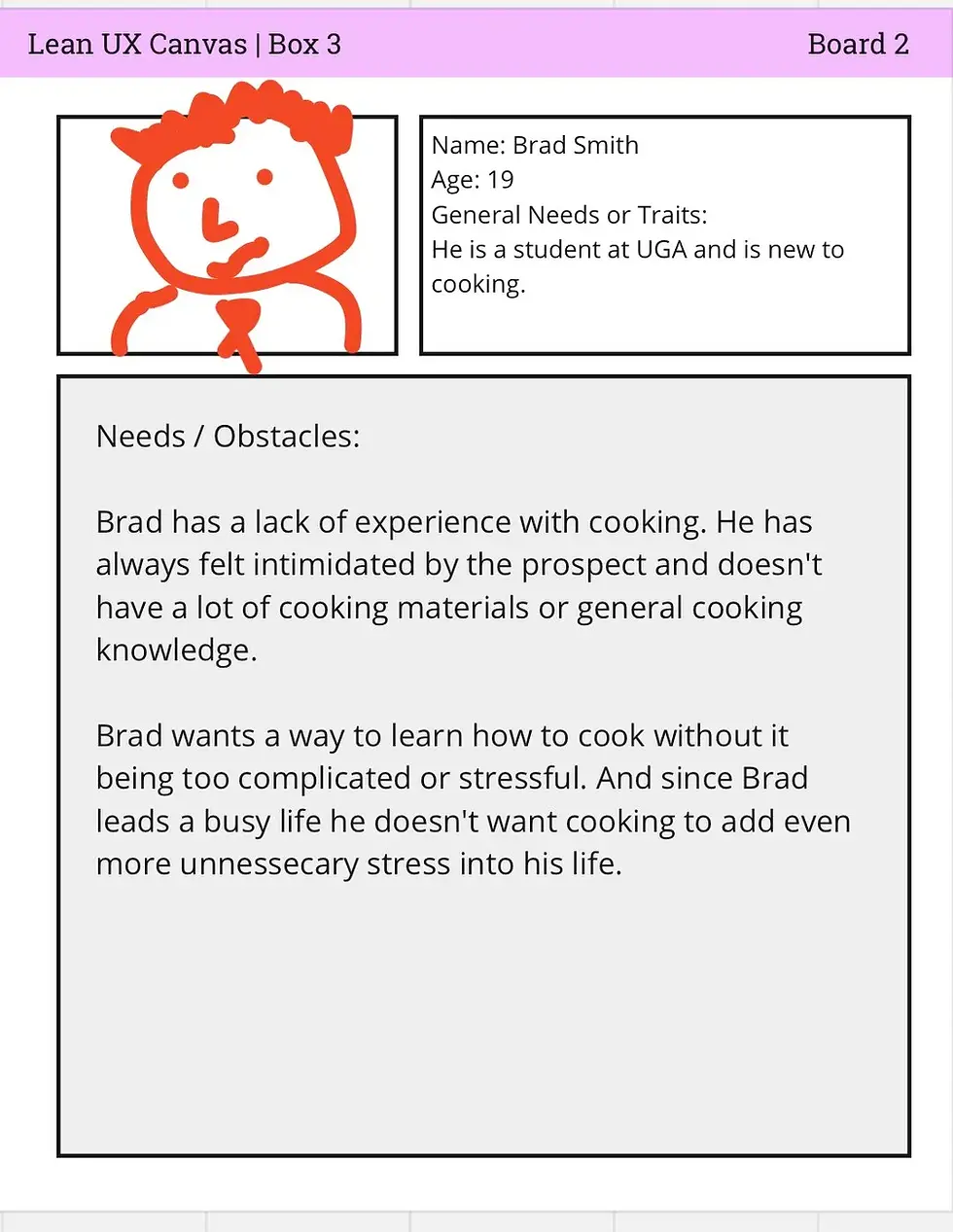
Originally, Brad only needed a solution for his lack of time management and inexperience with cooking. On the other hand, Brad evolved to wanting to have the option to filter his recipes and reassurance to ensure that he is on the right track as he learns, once the final proto-persona was created.
Hypothesis
In addition, Our team created various hypothesis which helped us progress towards our solution. Next, Our team prioritized them based on their perceived value and risk. The best hypothesis to test were our high value and high risk hypothesis. Therefore, the main hypothesis we ended up prioritizing included:
-
We will achieve increased user cooking knowledge if Brad can learn how to cook without prior knowledge with instructional videos.
-
We will achieve smart food usage if Brad can make meals w/o having to go shopping/do extra meal prep with a current ingredients-to-meal suggestion system.
-
We will achieve reduced user food waste if Brad can track and plan purchased food with a receipt scanner that keeps track of expiration dates
Solution
Sprint 1
Finally, our team created experiments that can further test our hypothesis for a possible solution. These hypotheses would be tested within 2 sprints. In our first experiment, we tested to see how resourceful people were and how willing they were to do something that they have no experience with such as creating something from a randomly assigned prompt. Participants were given a prompt to design a new mode of transportation only using materials that were readily available to them. Participants were not told about the prompt beforehand and weren't allowed to get extra aid with the design challenge. Each participant was given 15 minutes to complete the task.
Experiment 1
Our team ended up with multiple key findings from this experiment. Time Constraint was one of our main key findings in the conclusion of this experiment. Most new cooks are people who have busy lifestyles which makes cooking difficult to add into their schedules. However, we got split results on how our interviewees felt about the time constraint. In addition, Instructions played a role because users felt lost and pressured when given little to no instructions. All interviewees were conflicted while figuring out an invention due to little instruction. Finally, we found the importance of ingredients based on this experiment. Interviewees felt limited because they could only use what they had but found ways to make it work despite the limitations. As a result of these findings, our team identified the following:
-
Having a time filter for users that have time limitations.
-
Adding a Grocery list so user can keep track of the ingredients that they need.
-
As detailed but easy to understand instructions as possible


Lo-Fi wireframe
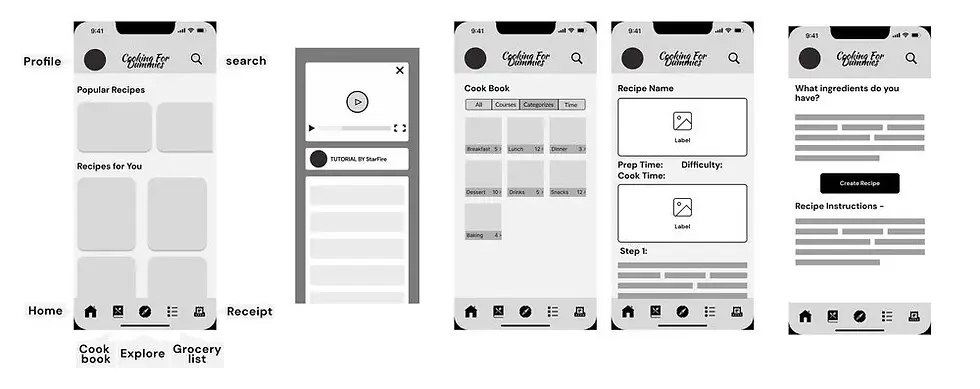
Our team started out by creating a low-fidelity wireframe to help give us an idea of how we wanted to lay out our app. We decided to begin with a low-fidelity wireframe so that we could make adjustments based on feedback before going into High-fidelity. We then were able to conduct 3 user interviews based on our demographic. These interviewees were college-age students with little to no experience cooking. This allowed our team to see if our Lo-Fi wireframes were beneficial for our demographic.
Key Takeaways
-
Thinking on the spot is challenging - Our participants expressed that thinking about concept ideas was the most difficult challenge. We also learned that all of our participants struggle to plan meals and don’t like structured recipes because they may lack the ingredients or tools required.
-
Positive reassurance - Since our participants during the design challenge didn’t exactly know what they had to build since we deliberately kept the prompt open, they said that they would have liked maybe a visual example or some time of reassurance that they are on the right track especially when they are doing something new for the first time including cooking.
-
Smart fridge benefit - We received feedback on creating a UI for a Smart Fridge. Our participants liked the idea due to losing track of food in their pantries and fridge. This also gives the opportunity for an easier option to follow along with recipes and track stocked food.
-
Unnecessary features - Some interviewees expressed that some of our features were vague. As a result, our team ended up ditching our receipt tracking feature due to many of our interviewees stating that they never would use this feature. There was also confusion on the filter options within the cookbook. Therefore, we ended up tweaking this around to make the cookbook more straightforward.
Sprint 2
In our second sprint, we aimed to validate whether users would become overwhelmed with step-by-step written instructions. We conducted another experiment in which participants were asked to solve a series of activities and riddles as part of a scavenger hunt throughout campus. We assigned one of three difficulties based on the opposite preference for instruction. Another purpose of this experiment was to research which learning methods would be most effective and how stress affects users' learning.
Not only were we able to see how well users reacted to the situation without prior knowledge, but we also were able to finalize which learning methods worked best. Each difficulty contained a different time limit and different combinations of learning methods (written, audio, visual). This allowed participants to be exposed to different styles of learning methods to see how it may have affected them along the way.

Hi-Fi Wireframe
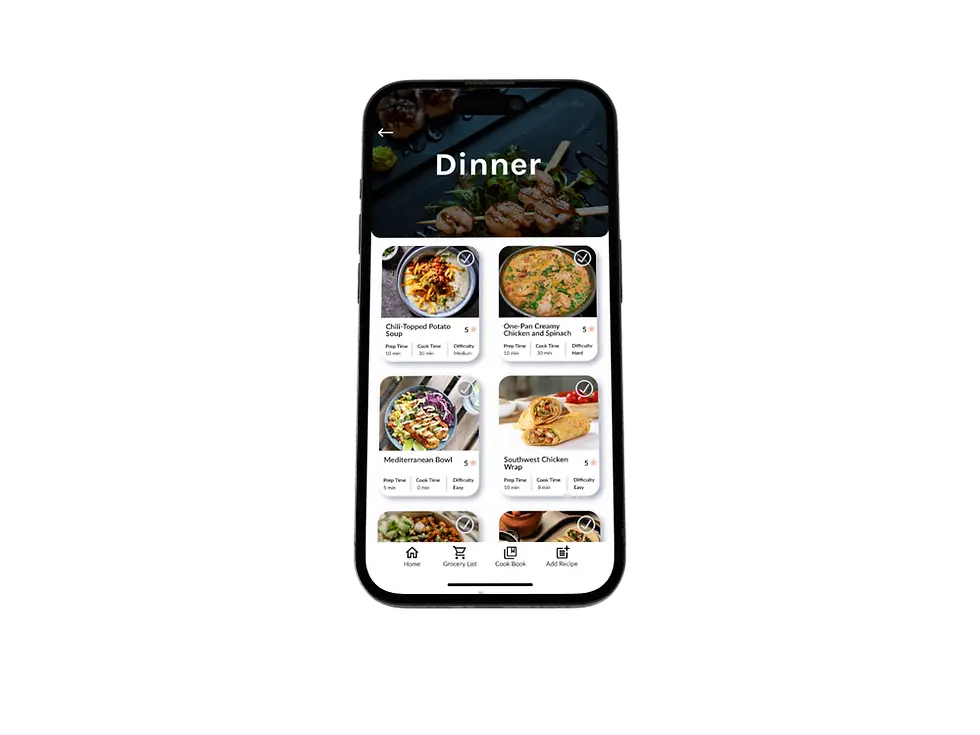
After gaining valuable feedback on our lo-fi wireframe, we decided to begin our high-fidelity prototype. Our team conducted another set of usability tests on this prototype. These usability tests were important to give us feedback for our refinement stage.


Reflection
There are various things that I have learned over the course of this project. One of the biggest things I improved on was building the team chemistry for the project. I found it important to understand the strengths and weaknesses of each team member because this is something I believe made the project better. This allowed me to gain knowledge from each team member to help me improve as a designer. In addition, our team did an amazing job of not panicking and staying ahead of schedule despite the fast pace of the project. This alleviated most of the time management concerns that we had throughout the process.
One thing I would do differently is work on my preparation. Throughout the research process, I could have spent more time preparing more questions and implementing small changes in our prototype to give more insight throughout the sprints. However, this is something that I will now improve on for future projects.